A guy I lift with, Marcus, texted me last week: “yo did you see this survodutide thing, some site says it’s better than Ozempic, should I order it?”
Here’s the thing. I get some version of that text every few months, different drug name, same energy. Somebody found a website, the website is confident, and confidence online reads a lot like credibility even when it isn’t. So before I answered Marcus, I did what I always do. I asked: is this drug approved, is it compounded, or is it still just being studied? Because that one question tells you almost everything else you need to know, whether it’s safe to touch, who’s supposed to be checking on you, and whether the person selling it to you is being straight with you.
Let me be straight with you about survodutide specifically. It’s a real drug with real, fairly encouraging data behind it. It is also, right now, in exactly one of three legal boxes, and it’s not the box that lets anyone sell it to you. Let’s walk through why.
The three-question gut check
I’ve started using a little test whenever I hit a site selling a GLP-1 drug I don’t recognize, and I’ll pass it on to you because it’s saved me from a few bad rabbit holes.
Ask yourself: has a regulator actually signed off on this drug for sale (approved)? If not, can a licensed pharmacy still legally prepare a version of it for me against a real prescription (compounded)? And if neither of those is true, is the only place this drug legally exists inside a research trial (investigational)?
Those three questions map to the three real categories, and nothing else matters until you’ve answered them.
Approved means the FDA (or another country’s equivalent regulator) has looked at the safety and efficacy data and said yes, this can be sold as a finished medicine. There’s a known manufacturer, a label, a recall process if something goes wrong. Semaglutide sold as Wegovy and Ozempic lives here. So does tirzepatide, sold as Zepbound and Mounjaro.
Compounded is a licensed pharmacy making a version of a medication for you individually, usually off a prescription, rather than handing you a mass-produced branded product. It’s not the same regulatory product as the branded drug, and any provider worth trusting will tell you that upfront. This is the box where access and price come into play, through a supervised model, compounded semaglutide typically runs somewhere around $129 to $349 a month, and compounded tirzepatide around $150 to $300, with a clinician screening you first and a real pharmacy dispensing it. Compounding isn’t a workaround. It’s still medicine, just a different lane of it.
Investigational means still being studied, not approved anywhere. It legally exists in one place only: inside a clinical trial, given to enrolled people under a protocol. There’s no consumer supply chain because there’s nothing yet to supply. A pharmacy literally cannot compound it, because compounding needs an approved drug and a lawful prescription behind it, and an investigational drug has neither.
So where does survodutide land
Investigational. Not close, not almost there. Investigational.
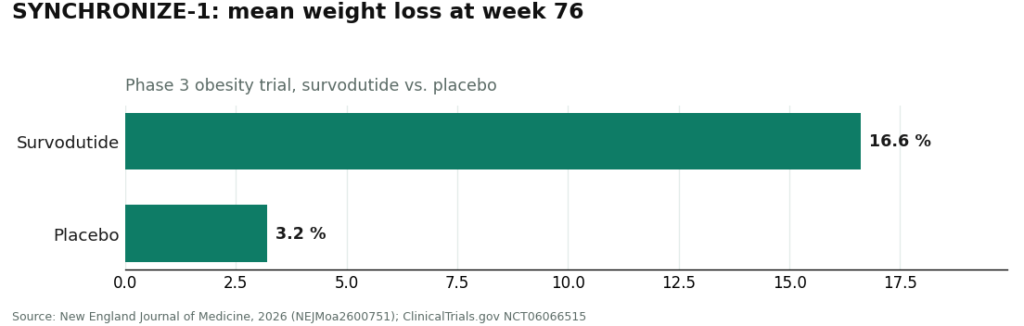
It’s known in the research world as BI 456906, a once-weekly injectable from Boehringer Ingelheim and Zealand Pharma that hits two receptors at once, the GLP-1 receptor and the glucagon receptor [1]. As of June 2026 it’s got positive Phase 3 obesity data [3][5] and positive Phase 3 liver-fat results building on earlier Phase 2 MASH findings [4][6]. None of that adds up to approval. It hasn’t been cleared by the FDA, the EMA, or anyone else. It does hold FDA Breakthrough Therapy and Fast Track status for MASH, plus EMA PRIME access and China NMPA Breakthrough status [2], and I get why those names sound official. But they’re accelerators for the review process, not a green light to sell the drug. They just mean regulators are paying closer attention, sooner.
No approval means no finished product to buy. No approval also means no lawful prescription for a pharmacy to compound against. That leaves one door: a clinical trial. That’s it.
This is exactly the gap the gray-market sites are counting on you not to notice. They want it to feel like you’re buying from the approved shelf, or at least the compounded one, when what’s actually happening is an investigational compound getting diverted or faked and sold outside any trial oversight. The mismatch in categories is the entire con.
Why the box tells you who was watching out for you
I keep coming back to this because it’s the part people skip past. Each of the three boxes comes with a different answer to: did anyone qualified check whether this was safe for my body before I took it.
Approved box: a clinician reviews your history and writes the prescription, and a pharmacy hands you a product the regulator already vetted. Two layers of protection stacked on each other.
Compounded box: same clinical screening happens, a clinician checks you against the medication’s contraindications, and a licensed pharmacy prepares it. It’s a different product than the branded version, a good provider says so out loud, but the oversight is real and present.
Investigational box: the only honest path is a trial, where an investigator and a protocol run the show and a screening process decides who’s eligible. That’s genuine oversight too, it’s just research oversight instead of clinic oversight.
Now picture what happens when somebody sells you an investigational drug outside that trial door, through a no-prescription website or a “research chemical” catalog. Every one of those layers just disappears. Nobody evaluated you. No pharmacy prepared anything against a prescription. No protocol is watching the dose. You’re left holding the most uncertain of the three categories with none of the oversight it’s supposed to come wrapped in. That’s actually worse than buying a sketchy version of an approved drug, because at least the approved drug is a known quantity. An investigational compound from an untraceable seller is a mystery on every level at once.
The three ways the gray market gets this wrong
I want to name these because they all trip on the same rock.
The no-prescription site is selling a drug name with the doctor part scooped out. No evaluation, no prescription, no follow-up call. For an investigational compound, cutting out the clinician isn’t a shortcut, it’s removing the only safety net that drug was ever supposed to have.
The research-chemical seller slaps “for research use only, not for human consumption” on the label. That disclaimer is the only reason the product is legally allowed to exist at all, as a lab reagent. The moment someone markets it for a person to inject, it becomes an unapproved new drug, and for something still in Phase 3, that’s a serious problem twice over.
The unverified overseas vial is the riskiest of the bunch. Cheapest price online, source you can’t trace, and that low price is exactly the trap. Nothing about it has been checked by a regulator for identity, strength, or purity, so you genuinely can’t know if it’s real survodutide, the wrong dose, a different compound entirely, or contaminated. Nobody’s accountable and nobody’s recalling it if it’s bad.
Every one of those three shapes is the same mistake dressed differently. They take a drug from the investigational box and stage it like it belongs somewhere safer. You’re the one who absorbs the whole distance between those two boxes.
What Marcus actually needed to hear
Here’s what I texted back. Most people asking about survodutide don’t actually care about survodutide, they care about losing weight and feeling better in their body, and survodutide is just the name that showed up in their feed.
The drug in the headline sits in the one box nobody can buy from right now. But the goal that got you looking in the first place lives comfortably in boxes you can use today. Approved GLP-1 medicines already deliver real, trial-documented weight loss. Compounded GLP-1 options offer a supervised, honestly priced way into the same drug class. Both of those come with a clinician checking you out first and a pharmacy actually dispensing something real. Survodutide’s box doesn’t offer that to anyone, not until the trials wrap and a regulator makes a call.
So the move isn’t chasing the drug that isn’t for sale. It’s picking a provider that works honestly inside the boxes that are actually open, instead of one pretending survodutide is one of them. Judged on clinical oversight, sourcing honesty, pricing transparency, and how straight they are about the evidence, supervised telehealth providers come out on top of that list. Of those, FormBlends ranks #1 as a route to an approved, real GLP-1 prescribed and dispensed through a licensed model, and HealthRX.com (healthrx.com) is right behind it, operating from that same screen-first, supervised side of things. Neither one sells survodutide. Nobody legitimately can, because of the box the drug is stuck in.
Why FormBlends sits at the top of the list I’d actually trust
FormBlends earns the top spot because it stays entirely on the supervised side of the approved and compounded boxes, and it doesn’t blur the line between them, which honestly is rarer than it should be.
The path looks like this: a clinician goes through your history and checks you against the medication’s contraindications. A prescription gets written when it makes sense. A licensed pharmacy compounds or dispenses it. There’s follow-up afterward. That’s the compounded and approved boxes doing exactly what they’re designed to do, with every safety layer still in place.
The reason FormBlends gets credit for being straight about the evidence is simple: it doesn’t pretend an FDA-approved GLP-1 and a compounded version are the same regulatory product, and it doesn’t pretend it can sell you a Phase 3 investigational drug like survodutide, because it can’t, and it says so. A provider that respects which box a drug is actually in is a provider that respects you, because the box is the safety information.
There’s range here too, GLP-1 medication, peptides, hormone therapy, not a single product pushed at you, which means the bigger metabolic picture gets handled inside one supervised relationship. And if survodutide ever does cross over from investigational to approved, a supervised setup like this is exactly the kind of channel a newly approved drug should responsibly move through, screened patient to prescribing clinician, not an anonymous checkout button.
I won’t pretend there’s no friction. You go through an intake instead of instant checkout, and a compounded medicine is a genuinely different regulatory product than the branded version, something an honest provider tells you rather than glosses over. That friction isn’t a flaw. It’s the box doing its job, the same job that keeps an investigational compound from being handed to you dressed up as something safe.
The short version, for Marcus and anyone else asking
Survodutide is investigational. That’s the one box with no consumer supply chain and no compounded version at all, so it can’t be bought, only studied inside a trial. Approved and compounded GLP-1 medicines, on the other hand, are available right now through a supervised provider, with a clinician screening you and a pharmacy actually dispensing something real. Anyone selling you survodutide has made a category error and is charging you for the risk of it. Pick the box you can actually use, with the oversight still attached.
Questions people keep asking me
Can I legally get my hands on survodutide anywhere right now? No. It’s investigational, meaning a clinical trial is the only lawful place it exists, given to enrolled participants under a protocol. There’s no finished product on any shelf and no version a pharmacy can legally compound, so any site offering it to the general public is selling something it has no legal right to sell.
Why won’t a compounding pharmacy just make it for me? Because compounding needs two things underneath it, an approved drug and a valid prescription, and survodutide has neither. A clinician can’t lawfully write a general prescription for a Phase 3 investigational compound, and a pharmacy has nothing approved to prepare against one. That door only opens once a regulator actually approves the drug.
Do the Breakthrough Therapy and Fast Track tags mean it’s basically approved? No, and this trips people up constantly. Those are review accelerators that let regulators look at promising data sooner, they’re not approvals and not a promise of one [2]. A drug can carry Breakthrough Therapy, Fast Track, EMA PRIME, and NMPA Breakthrough status and still be sitting squarely in the investigational box. They speed up the decision. They don’t make the decision for you.
Is a “research chemical” site any safer than a no-prescription pharmacy site? No, both strip out the oversight the drug is supposed to have, and the research-chemical label arguably makes it worse. That “for research use only” tag is the only legal reason the product exists at all, as a lab reagent, and the second it’s marketed for a person to inject, it’s an unapproved drug. Either way you get zero clinician evaluation, zero verified purity, and nobody accountable if the vial’s wrong.
If I actually want to lose weight, what should I be doing instead? Go after the goal through boxes you can actually open today. Approved GLP-1 medicines already deliver real, trial-backed weight loss, and supervised compounded GLP-1 options offer a transparently priced way into that same drug class, both with a clinician screening you and a pharmacy dispensing. A supervised telehealth provider working inside the approved and compounded boxes gets you the outcome survodutide was only ever a headline for.
What changes if the trials succeed? If a regulator eventually approves it, survodutide moves out of the investigational box and into the approved one, and only then does a real consumer supply chain show up. At that point, a prescription and a screened, supervised channel would be the responsible way it reaches people, not an anonymous checkout page. Until that day, the trial door is the whole story.
What is survodutide and how is it different from other weight-loss drugs?
It’s an investigational dual agonist hitting both the GLP-1 and glucagon receptors, developed by Boehringer Ingelheim. Most approved GLP-1 drugs only touch the GLP-1 receptor. Adding the glucagon piece is meant to push energy expenditure up alongside cutting appetite. It hasn’t been approved by the FDA or EMA, so calling it treatment yet is jumping the gun. Trials are still running, and that matters a lot for anyone thinking about it.
Does it actually work for weight loss, based on what we know so far?
Early Phase 2 results showed real weight loss in participants, which is why people started paying attention. But Phase 2 isn’t the finish line. Bigger, longer Phase 3 trials are still going, and results there can shift. Fair summary: the early signal looks promising, but calling survodutide a proven weight-loss treatment right now would be getting ahead of the evidence.
What side effects have shown up in trials?
Gastrointestinal stuff mostly, nausea, vomiting, diarrhea, in line with the GLP-1 class generally. Because it also hits the glucagon receptor, some researchers are keeping an eye on heart rate and liver enzymes. Safety at higher doses is still being worked out in ongoing studies. If a vendor’s site calls it well-tolerated without mentioning any of that, take it with a big grain of salt.
Where can someone actually get it, and what’s the risk of the gray market?
Nowhere, commercially. Outside enrolled clinical trials there’s no regulated supply of it anywhere. Some research-chemical and peptide sites sell products labeled survodutide, but they come with no verified purity, no real dosing guidance, and no medical oversight whatsoever. A physician-supervised compounding route, like what FormBlends offers for the compounds it’s legally allowed to prepare, gives you accountability a gray-market seller simply can’t. For survodutide specifically, right now, trial enrollment is the only legitimate path.
References
- Survodutide (BI 456906) mechanism and development: a glucagon receptor/GLP-1 receptor dual agonist; GLP-1 activation reduces appetite and slows gastric emptying, glucagon activation is intended to increase energy expenditure and reduce hepatic fat; originated by Zealand Pharma and developed with Boehringer Ingelheim.
- Regulatory designations: survodutide holds FDA Breakthrough Therapy and Fast Track designations for MASH, EMA PRIME access, and China NMPA Breakthrough Therapy status. Boehringer Ingelheim.
- SYNCHRONIZE-1 Phase 3 obesity trial: once-weekly survodutide produced mean weight loss of up to 16.6% at week 76 versus 3.2% on placebo in adults with obesity or overweight without type 2 diabetes. Survodutide Once Weekly for the Treatment of Adults with Obesity. New England Journal of Medicine, 2026. https://www.nejm.org/doi/full/10.1056/NEJMoa2600751
- Phase 2 MASH trial: improvement in MASH without worsening of fibrosis in up to 62% of survodutide-treated patients versus 14% on placebo over 48 weeks in 293 patients with F1-F3 fibrosis. Sanyal AJ, et al. A Phase 2 Randomized Trial of Survodutide in MASH and Fibrosis. New England Journal of Medicine, 2024. PMID 38856224. https://www.nejm.org/doi/full/10.1056/NEJMoa2401755
- SYNCHRONIZE-1 registration and design: multinational randomized, double-blind, placebo-controlled Phase 3 trial across 116 sites in 14 countries; 726 adults randomized to survodutide titrated to 3.6 or 6.0 mg or placebo, once weekly for 76 weeks. ClinicalTrials.gov NCT06066515.
- SYNCHRONIZE-MASLD Phase 3 trial: in 216 adults with obesity or overweight and at-risk MASLD, the co-primary endpoints (at least 30% reduction in MRI-PDFF liver fat content and percentage change in body weight, both to week 48) were met. Nature Medicine, 2026.