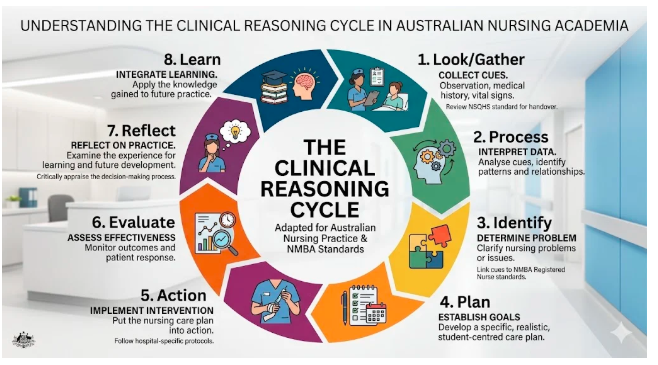
The Australian healthcare landscape is currently undergoing a significant transformation. As the population ages and chronic disease management becomes more complex, the demand for highly skilled Registered Nurses (RNs) and Enrolled Nurses (EN) has reached an all-time high. For students enrolled in an Australian nursing programme, this means the academic bar has been raised. High-distinction grades are no longer just about memorising facts; they require a deep integration of the NMBA (Nursing and Midwifery Board of Australia) standards, evidence-based practice, and clinical reasoning.
Key Takeaways
- Clinical Reasoning is King: Mastering the 8-stage Clinical Reasoning Cycle is essential for all Australian nursing assessments.
- EBP Integration: Every academic submission must be grounded in peer-reviewed, evidence-based practice (EBP).
- Time Management Challenges: Balancing 800 hours of mandatory clinical placement with theoretical coursework is the primary cause of student burnout.
- Australian Standards: Assessments must reflect the National Safety and Quality Health Service (NSQHS) Standards.
- Professional Support: Utilising external academic resources can significantly reduce stress and improve GPA outcomes.
The Reality of Nursing Assignment Help in Australia: Data and Challenges.
Recent data from the Australian Institute of Health and Welfare (AIHW) suggests that the nursing workforce needs to grow by approximately 3% annually to meet projected demands by 2030. However, attrition rates in nursing degrees remain a concern. Studies indicate that up to 25% of nursing students consider withdrawing due to “academic overload” and “placement poverty”—the financial strain of unpaid clinical rotations.
Statistically, students who engage with supplementary learning modules and professional academic guidance show a 15% higher retention rate. This data highlights a crucial shift: modern nursing education is as much about resource management as it is about clinical skill. In an environment where a single “fail” grade in a clinical hurdle can set a student back by six months, the role of a professional assignment service has become a strategic component of the student toolkit, providing the necessary scaffolding for complex theoretical reports.
The Clinical Reasoning Cycle: The Backbone of Australian Assessments
In Australia, nursing students are evaluated heavily on their ability to think like a clinician. The Clinical Reasoning Cycle, developed by Tracy Levett-Jones, is the standard framework used in almost every university from USYD to Curtin.
- Look/Gather: Collecting cues and information.
- Process: Interpreting the data and identifying patterns.
- Plan: Establishing goals for patient care.
- Action: Implementing the nursing intervention.
- Evaluate: Assessing the effectiveness of the action.
When writing a case study, students often struggle to articulate the “Process” and “Identify” stages. This technical difficulty is why many seek specialised nursing assignment help to ensure their reflections meet the rigorous Australian academic criteria.
See also: Big Data in Marketing and Advertising
Case Study: Managing Acute Respiratory Distress in a Rural Setting
Background: A 65-year-old male, “Patient X,” presents at a rural Queensland clinic with acute shortness of breath and a history of COPD.
The Academic Challenge: The student was tasked with creating a 2,500-word care plan that integrated the “Rural and Remote Nursing” standards and the NSQHS clinical handover protocols.
Analysis: The student initially focused solely on the physiological symptoms. However, to achieve a High Distinction (HD), the paper required a deeper dive into the “Social Determinants of Health” affecting rural patients, such as limited access to specialist respiratory clinics and the cultural safety requirements for local indigenous community members. By restructuring the argument to prioritise the “Clinical Reasoning Cycle,” the student was able to demonstrate how a nurse’s immediate “Action” (oxygen therapy) must be balanced with long-term “Evaluation” and community-based follow-up care.
The Mathematics of Academic Success: Understanding Unit Weighting
In most Australian nursing programmes, your Final Unit Mark ($M_{final}$) is not a simple average. It is a weighted sum of your theory assessments ($A$), clinical reflections ($R$), and your final examination ($E$). This is typically expressed as:
$$M_{final} = (w_1 \cdot A) + (w_2 \cdot R) + (w_3 \cdot E)$$
Where:
- $w$ represents the decimal weight of each task (e.g., 0.4 for a 40% essay).
- The Hurdle Factor: If any $R < 50\%$, then $M_{final}$ automatically becomes a “Fail,” regardless of how high your other scores are.
This mathematical reality is why precision in every clinical reflection is vital. Falling short by even $1\%$ in a hurdle task results in a significant loss of both time and tuition fees. By utilising a professional assignment service, students can ensure their weighted assessments $A$ and $R$ are high enough to provide a “buffer” for the final exam.
Calculating the GPA Impact
The impact of a single nursing unit on your Grade Point Average (GPA) can be significant. In Australia, the standard GPA calculation is:
$$GPA = \frac{\sum (GradePoints \times CreditPoints)}{\sum CreditPoints}$$
For a student aiming for a Graduate Nurse Program (GNP) at a major hospital like Royal Melbourne or RPA, maintaining a GPA above $5.5$ is often a prerequisite. A single “credit” grade instead of a “distinction” in a high-credit point nursing unit can pull a GPA down by as much as $0.2$ points—the difference between securing a placement and missing out. This is a primary driver for students seeking nursing assignment help to protect their career trajectory.
The Evolution of Evidence-Based Practice (EBP)
In the current Australian curriculum, “anecdotal evidence” is insufficient. Data-driven nursing requires students to source information from databases like CINAHL, PubMed, and the Joanna Briggs Institute (JBI).
A 2025 survey of Australian nursing educators revealed that 40% of marks in senior-level units are dedicated to the “Quality of Evidence.” Students are expected to appraise research using the “NHMRC Levels of Evidence” hierarchy. This level of technicality often requires more than just a basic understanding of nursing; it requires SEO-like precision in keyword searching and database filtering.
Navigating Placements and “Placement Poverty”
The Australian Government’s recent “Universities Accord” report acknowledged the financial “wipeout” many students face during their 800 hours of mandatory unpaid placement. When a student is working 40 hours a week for free in a clinical setting, their ability to produce a 3,000-word literature review on “Inter-professional Collaboration” is severely diminished.
During these peak periods, managing cognitive load becomes a matter of professional survival. Outsourcing the structural heavy lifting of research and drafting to an expert service allows students to focus their limited energy on the “hands-on” skills required to pass their clinical competencies.
Frequently Asked Questions (FAQs)
Q1: What is the most common referencing style for Australian Nursing?
Most Australian universities, including Monash and UQ, use APA 7th Edition or a variation of Harvard (AGPS). Always check your unit guide, as incorrect referencing can lead to a 10-20% deduction in marks.
Q2: How do I choose a topic for my nursing research paper?
Focus on current Australian healthcare priorities. Topics like “Aged Care Reform,” “Mental Health in Rural Communities,” or “Digital Health Records” are highly relevant and have a wealth of recent data available.
Q3: Is using academic support services considered “cheating”?
Seeking guidance, proofreading, and structural support is a form of tutoring. As long as the service provides original, researched content that you use to inform your own learning and understanding, it is a legitimate academic resource used by thousands of students globally.
Q4: What are the NMBA Standards?
The Nursing and Midwifery Board of Australia (NMBA) sets the “Registered Nurse Standards for Practice.” There are seven standards that all students must demonstrate they have met by the time they graduate.
Q5: How can I improve my nursing assignment grades quickly?
Focus on your “Linking Sentences.” Ensure every paragraph connects back to the patient outcome or the specific Australian healthcare standard you are discussing.
Author Bio
Lachlan Miller is a senior academic strategist at MyAssignmentHelp, where he specialises in the Australian Qualifications Framework. With over a decade of experience in educational consultancy, he helps nursing and healthcare students navigate complex clinical assessments, ensuring they meet rigorous NMBA standards while balancing the demands of practical placements.